


 Posted an update: 2026-4-1 13:28:58 121
In the mind of an ancient Chinese artisan, a bronze vessel was never just a container—it was a living creature. The zoomorphic art of the Shang and Zhou dynasties brings a fierce and magical world of tigers, dragons, and birds to life in cold metal.
Zoomorphic Bronze: The Symbolic Power of Ancient Chinese Animal Art
Ancient Chinese bronzes are famous for their "animal-centric" aesthetic. Whether through the abstract Taotie mask or the naturalistic sculptures of stalking tigers and soaring phoenixes, zoomorphic motifs served as spiritual mediators between the human world and the divine. These designs were deeply symbolic, representing the power of nature and the lineage of the ruling clans.
1. The Stalking Tiger: Power and Protection
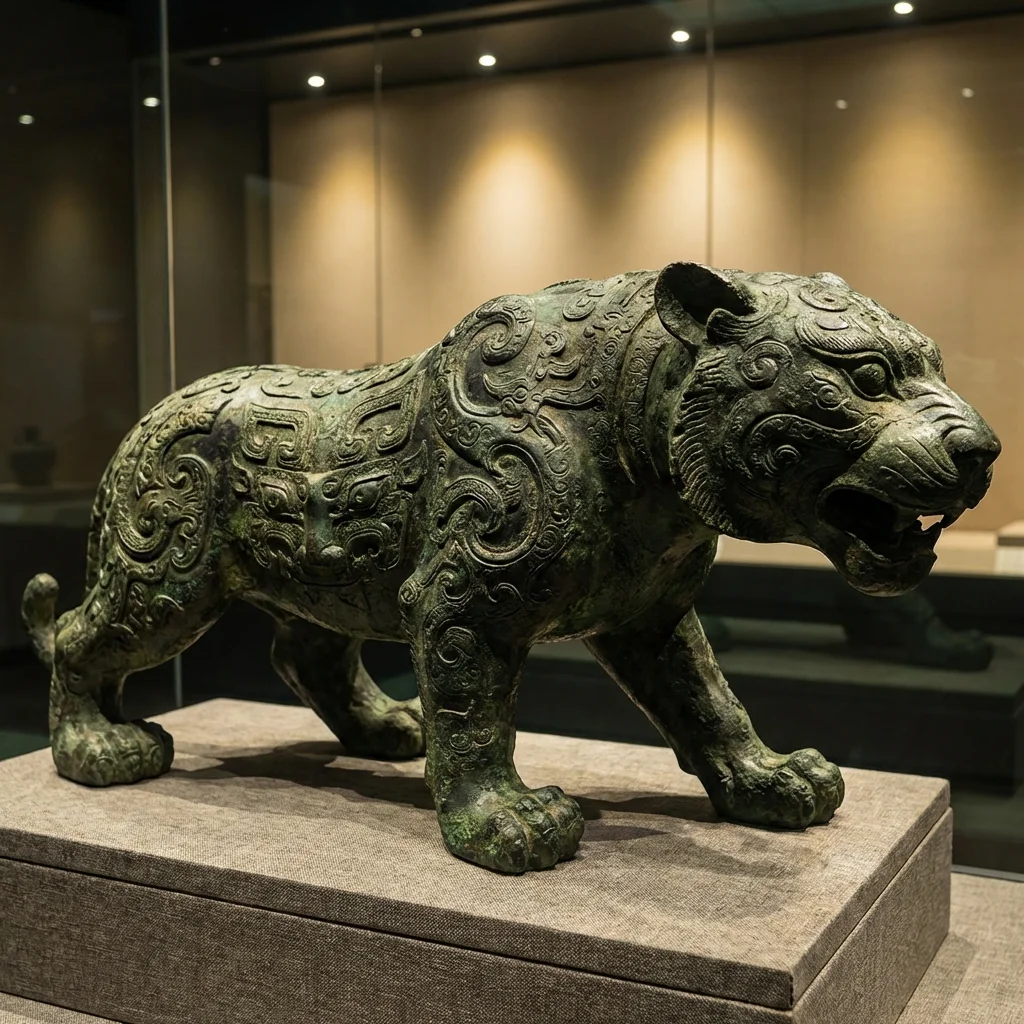
Tigers were revered as the "King of Beasts" in ancient China. In bronze art, they are often depicted as handles, feet of vessels, or standalone sculptures. A stalking tiger in bronze was a powerful symbol of military might and ritual protection. The surface of these tigers is often carved with intricate spiral patterns that mimic both fur and spiritual energy, blending the real with the supernatural.
2. The Dragon: Ruler of the Waters and Heavens
The dragon is the most enduring symbol of Chinese culture. In the Bronze Age, dragons (Long and Pan-long) were depicted in fluid, serpent-like forms that coiled around the necks of wine vessels. They represented the life-giving power of water and the unpredictable nature of the heavens. Unlike the later "Imperial Dragon," these early versions were more primal and often combined with features of snakes and birds.
3. The Bird and the Phoenix: Messengers of the Gods
Birds, especially owls and phoenix-like creatures, are common motifs in Shang bronzes. The owl (Xiao) was seen as a guardian of the night and a symbol of sacrificial purity. Phoenixes (Feng-huang) represented the harmony of the universe. These bird motifs often featured exaggerated crests and talons, emphasizing their role as divine messengers that could travel between the earth and the sky.
4. Hidden Complexity: The "Animal-Within-Animal" Style
One of the most fascinating aspects of zoomorphic bronze is its layered complexity. If you look closely at a single Taotie mask, you might find that the "eyebrows" are actually two small dragons, and the "ears" are small birds. This multivalent imagery reflects a shamanistic worldview where nature was seen as a complex, interconnected web of spiritual forces.
5. FAQ: Understanding Zoomorphic Bronze
Are the animals realistic?
They vary. Some, like the bulls and tigers, are very naturalistic. Others, like the dragons and Taotie, are highly stylized and symbolic "composite" beasts.
What is the most common animal motif?
The Taotie mask is the most prevalent, followed by dragons, tigers, and various types of birds.
Did other cultures have similar animal bronzes?
While many cultures used animal motifs, the "all-over" surface decoration and the symbolic complexity of ancient Chinese zoomorphic bronze are unique in the world of metallurgy.
6. Conclusion
Zoomorphic bronze is a window into the imagination of a civilization that saw no gap between the natural and the divine. These creatures in metal remain as fierce and captivating today as they were 3,000 years ago, reminding us of the timeless power of animal symbols in the human story.
Curious how these creatures were born? Next, we reveal the secrets of the Section-Mold Casting technique!