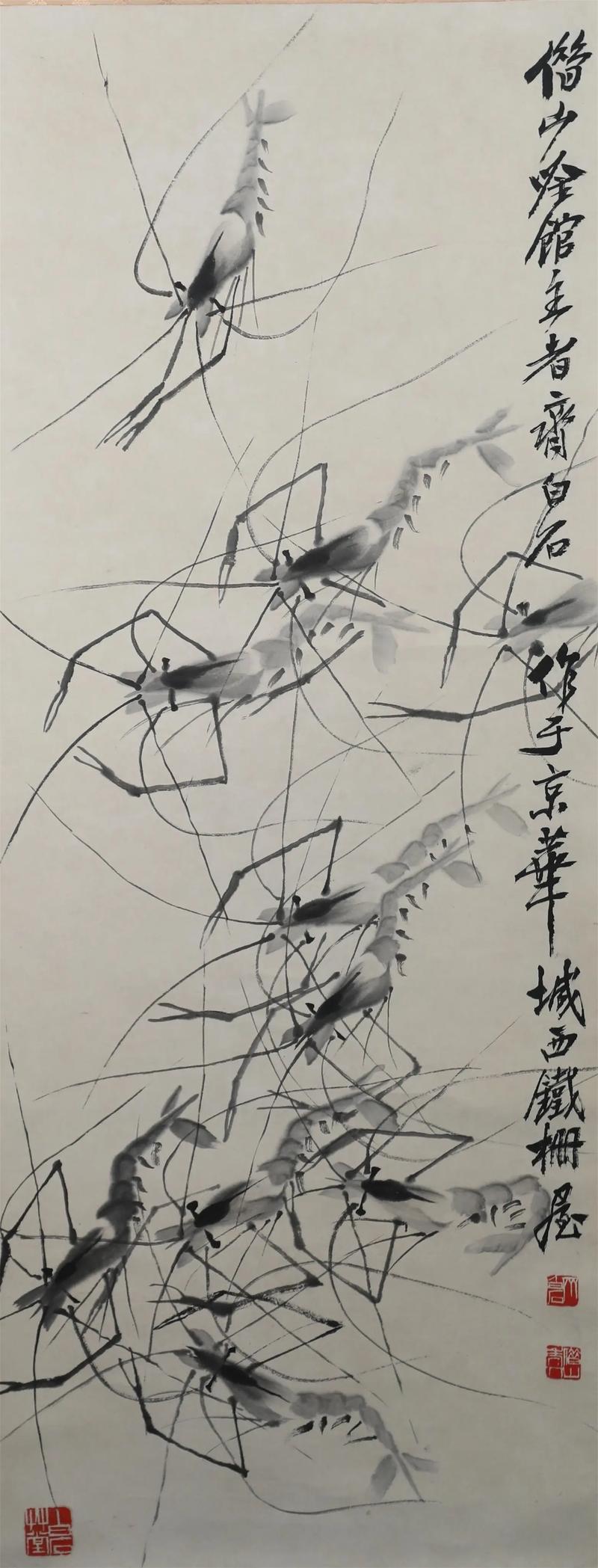
Shrimps
From childhood, Qi Baishi lived by a pond and often amused himself by fishing for shrimp. In his youth, he began to paint them, and around the age of forty he made copies of shrimp depicted by such Ming and Qing painters as Xu Wei and Li Fugang. [10] To paint shrimp with mastery, Qi Baishi kept numerous live shrimp at home, observing their habits and every movement with meticulous attention to detail. [4] He put forward the creative principle of “constantly observing the shrimp’s ever-changing movements,” and through prolonged observation and life drawing, gradually mastered the shrimp’s form and dynamic characteristics. [4] [10]
Qi Baishi’s depictions of shrimp underwent numerous innovations. As he himself remarked, “My paintings of shrimp have changed several times: at first they were only vaguely similar; in the second phase they became lifelike; and in the third, I began to render their colors in varying shades of light and dark. These constitute my three major transformations.” [4] [10] In his early shrimp paintings, Xu Beihong primarily adopted a realistic style, with the ten shrimp legs appearing somewhat elaborate; later, he heightened the sense of weight by rendering the shrimp heads with dense ink, and altered the shrimp eyes from simple dots to short horizontal strokes, thereby endowing the shrimp bodies with a translucent quality. After the age of seventy, the shrimp’s legs are further simplified to five segments, while its antennae alternate between straight and curved, appearing broken yet still connected. [4] Qi Baishi once remarked, “It took me decades of painting shrimp to finally capture their spirit.” Only through painstaking effort and repeated refinement can one fully harness the expressive potential of paper, brush, and ink, and master the natural diffusion of ink on Xuan paper.
In Qi Baishi’s late works, such as “Shrimp in a Group,” the shrimp bodies are arranged with varying densities and spatial rhythms, their movements rendered vividly alive. The antennae extend gracefully with each motion, while the tail is suggested with just a few deft strokes, capturing both elasticity and translucence; the front claws open and close with effortless ease. [4] In his “Shrimp in a Group” painting of 1944, Qi Baishi rendered the shrimp’s heads with light ink, and while they were still slightly damp, he outlined the rostrum and eyes with rich, dark ink. This technique, known as “breaking the ink,” employs bold strokes to set off the delicate, translucent body of the shrimp. [8] Qi Baishi’s “Shrimp in a Group,” created when he was eighty-one, is his water-
Reviews
No reviews yet.