Qi Baishi's Self-Portraits — The Iron-Willed Master Who Stood Apart from the Crowd
Heritage News
Editorial Team
In the world of Chinese painting, no one painted more self-portraits than Zhang Daqian — a rough count puts the number at over a hundred. With such abundance in quantity, quality, and stylistic variety, few artists have dared to paint Daqian's own likeness. Qi Baishi, by contrast, left behind only a handful of self-portraits during his lifetime — a mere fraction of Daqian's output. Yet after the founding of the People's Republic of China, Qi Baishi's reputation soared and his artistic stature rose steadily. A veritable tide of portraitists lined up to paint the master — how many celebrated artists ultimately depicted him remains a question for further research.
In my memory, Qi Baishi's earliest self-portrait is the painting Three Oddities of the Western City. The art historian Li Song, upon hearing that I was collecting self-portraits, specially photocopied a colour self-portrait by Qi Baishi from The Complete Works of Modern Chinese Art: Chinese Painting and annotated it by hand. The painting — titled Three Oddities of the Western City — was created in the second month of the bingyin year (1926), dedicated to the monk Xue'an (also known as Rui Guang) with the inscription "for your amusement."
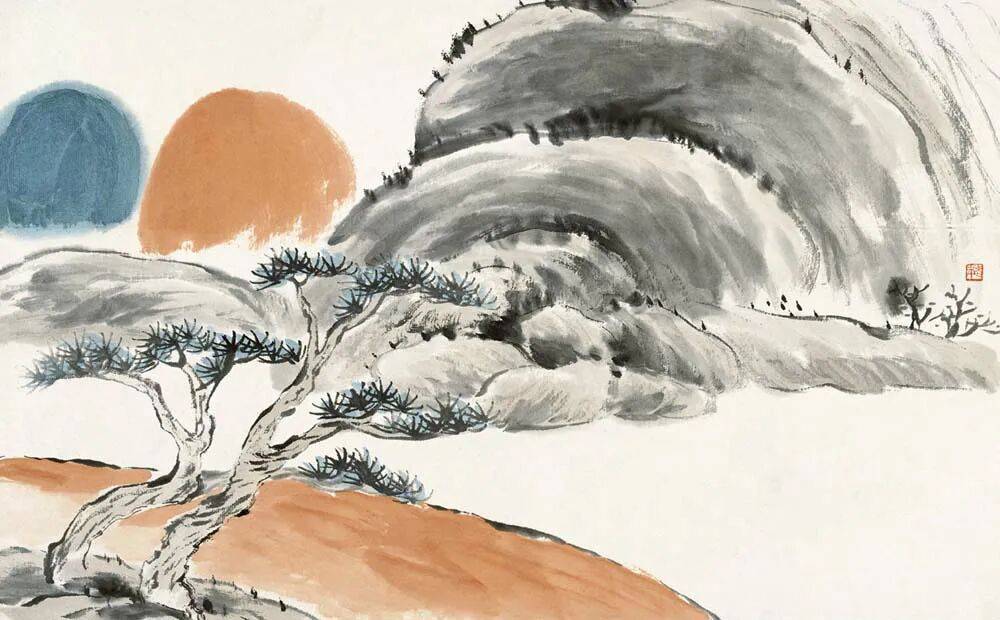
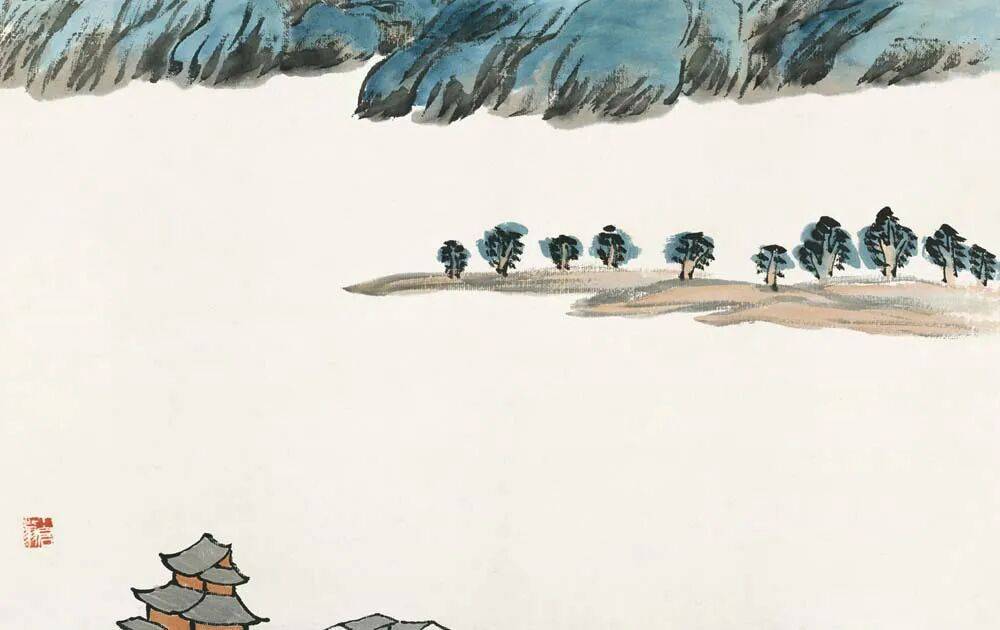
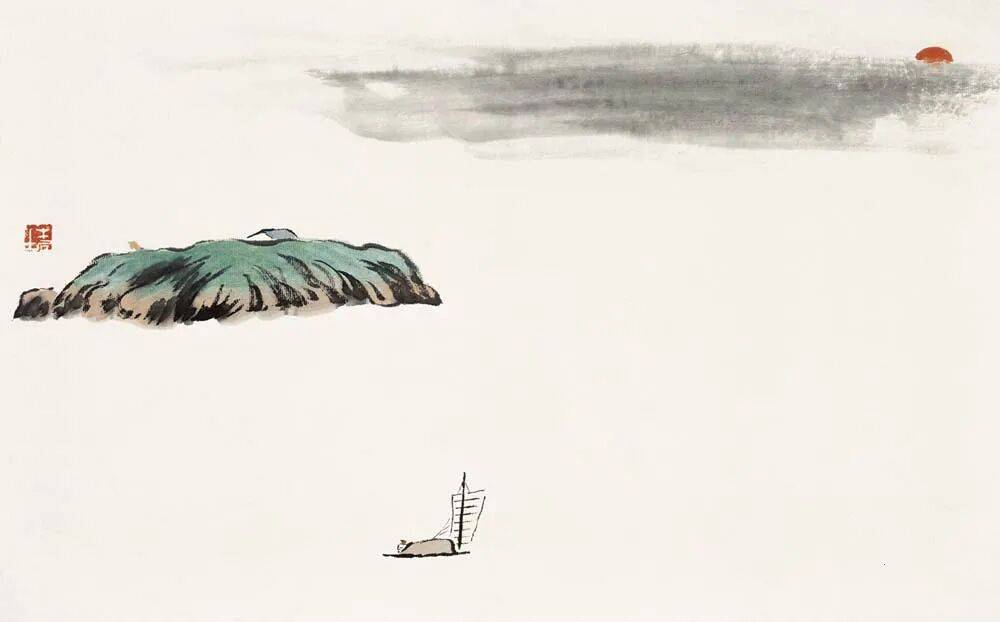
In 1917, Qi Baishi fled his hometown to escape rural unrest and came to Beijing, where he stayed at the Fayuan Temple outside Fucheng Gate. There he befriended the monk Rui Guang, who once copied Qi Baishi's Borrowed Mountain Scroll from memory and subsequently became his disciple. Qi Baishi wrote a poem about searching for Rui Guang at the Fayuan Temple: "Within the imperial capital's abbot's quarters, a thousand officials I have known; to cast one painting aside with a cold eye is hard to do alone. Fortunate it is that Rui Guang holds respect sincere — he treats the man as one would treat the noble seer." In the first month of 1932, Rui Guang passed away at the Lotus Temple; Qi Baishi went in person to weep and offer sacrifices.
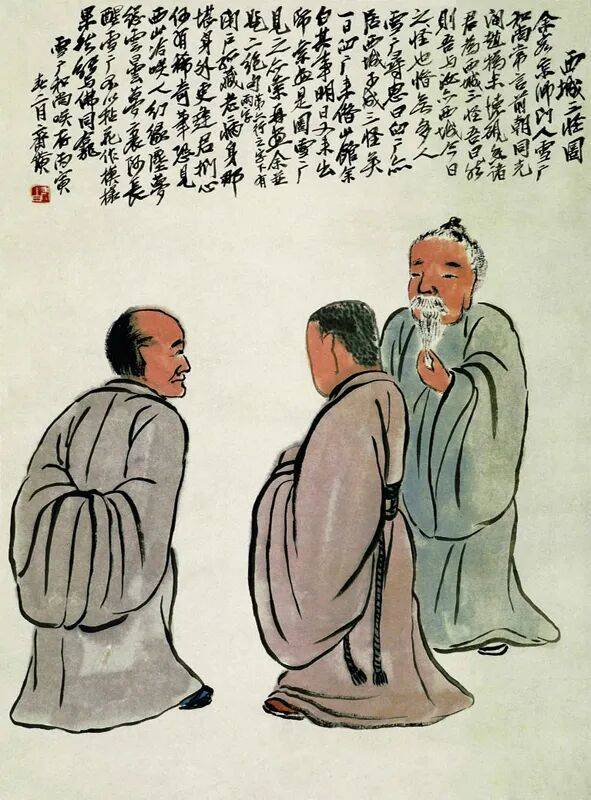
In Three Oddities, the old man on the left in a grey-blue long robe, with long hair and hands folded behind his back, is the artist himself — smiling and looking levelly to the right at the monk Rui Guang in the centre. Qi inscribed a lengthy colophon explaining the origin of the painting: his disciple Xue'an had told him about the "Three Oddities of the Western City" from the Tongzhi-Guangxu era, and suggested that with the addition of the monk Jiuan, the three of them could become the modern-day three oddities. One day Jiuan came to borrow the mountain studio, Qi recounted the matter, and the next day Jiuan returned with paper, requesting the picture. Xue'an saw it and asked for a copy too — so Qi painted another. He then inscribed two jueju poems:
"Shut away, I hide my old and ailing self — how could I bear to meet you beyond these shelves? Searching my heart, I find no wondrous brush; I fear the western hills will laugh and blush."
"Illusions, dusty dreams — all clouds and morning dew; in dreams, Achang — awake, Xue'an too. To pluck a flower as a model you may dare; truly, with Buddha we share the same lair."
He closed: "For the monk Xue'an to keep with a smile. Second month of the bingyin year, spring, by Qi Huang."
The Self-Portrait for Xu Beihong
The Beijing Fine Art Academy also preserves a figure painting of an old man in a warm hat and long robe, leaning on a staff, seen from behind. A closer look reveals it to be another self-portrait by the master. Two poems are inscribed on it, each with notes:
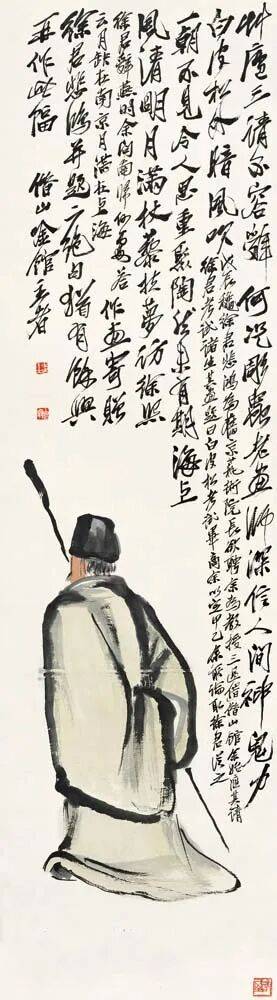
Poem One: "Three visits to my thatched hut — I could no longer decline, much less an old painter of insects so fine. Deeply I believe in the spirits' hidden power; beyond the white-bark pines, dark winds this hour."
(Note: In the wuchen year, Xu Beihong became dean of the Beijing Art Academy and wished to hire me as a professor. He came three times to Borrowed Mountain Studio before I finally accepted. When Xu examined students, the painting topic was White-Bark Pine. After the exam, I recommended the best works, and Xu followed my judgment.)
Poem Two: "A single day without you, and already I yearn; to reunite at Tao Ran Pavilion — when shall that turn? Clear winds over the sea, bright moon in full bloom; leaning on my staff, I follow dreams to visit Xu's room."
(Note: When Xu took leave of the capital, I asked where he would go south. He replied: when the moon wanes, I am in Nanjing; when it is full, I am in Shanghai.)
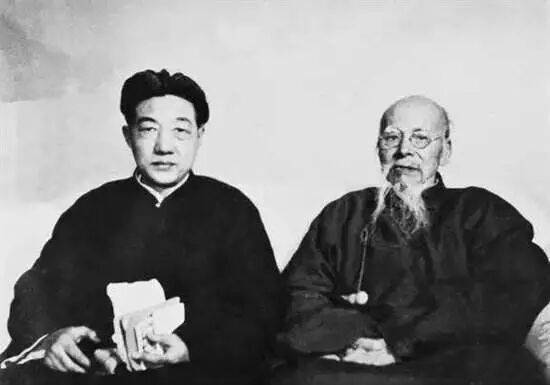
In the autumn of 1928, Xu Beihong accepted the post of dean at the Art Academy of Beiping University. Upon taking office, he visited Borrowed Mountain Studio three times to earnestly invite Qi Baishi to become a professor. Qi finally agreed, and Xu personally accompanied students to attend his lectures. At the time, Qi had been selling paintings in the capital for over a decade and had gradually built a reputation — but jealousy and slander from fellow painters were rampant. Xu Beihong, however, praised Qi's work to everyone he met, giving Qi the support he needed to stand firm against public criticism and reinforcing his creative courage. Xu was, after Chen Shizeng and Lin Fengmian, yet another kindred artistic spirit who held Qi Baishi in the deepest respect.
Due to student unrest at the academy, Xu was forced to resign after only three months and returned to teach at Nanjing Central University. Qi Baishi was devastated to see him go. As Xu bade farewell, Qi painted this self-portrait and inscribed it with the poems above as a parting gift. According to Wang Zhen's Chronicle of Xu Beihong, after Xu resigned in late January 1929, Qi also stopped going to the academy. When the academy repeatedly asked him to return, he wrote a note for his family to hand to the messenger: "Qi Baishi is dead!" — using his own resignation and repeated refusal of the academy's pleas to voice his indignation at Xu Beihong's forced departure.
"You Scold Me, I Scold Back Too"
Two years later, in 1930, Qi Baishi painted another self-caricature — You Scold Me, I Scold Back Too — as a riposte to the treachery and mutual backbiting of the Beiping art world. After the Republic was established, two major painting societies dominated Beiping: the Chinese Painting Research Association, led by Zhou Zhaoxiang and Jin Cheng, and after Jin Cheng's death in 1926, the Hu Society founded by his son. The presidents and chairmen exploited their social positions to expand influence, jostling and undermining one another. Locally-born painters took pride in joining a society for protection; outside painters seeking a foothold in Beiping and the chance to sell their work had no choice but to pay obeisance to the society heads — without such patronage, they could not survive on this turf.
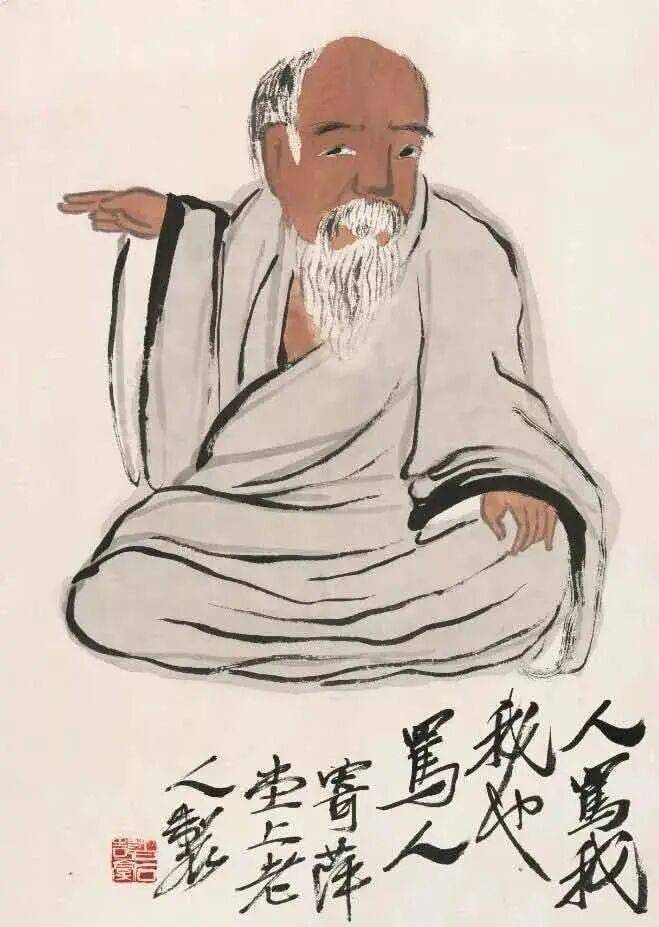
Qi Baishi came from a humble background and was an outsider from western Hunan — without power or influence. He disdained the behaviour of these painters; whenever someone tried to recruit him into a society, he declined. As a result, he was frequently ridiculed by society members. Some mocked him for affecting literary refinement, saying his poetry resembled the "Xue Pan style." Qi himself recorded the origin of this barb in The Autobiography of the Old Man Baishi: in 1899, when he formally became a disciple of the late-Qing literary giant Wang Kaiyun, a fellow disciple told him, "Master Xiangqi says your prose is presentable enough, but your poetry is like that of Xue Pan, the 'Stupid Tyrant' from Dream of the Red Chamber." Qi reflected, "That remark hit upon my real flaw. The poems I write simply express what is in my heart without ornamenting a single word on the surface. Looking at them myself, I do indeed detect a whiff of that Stupid Tyrant!"
A kindly criticism from Wang Xiangqi, the eminent late-Qing man of letters, had been twisted by jealous colleagues into a malicious taunt. In response, Qi painted You Scold Me, I Scold Back Too and carved a large square seal measuring two cun on each side, bearing the inscription: "No Connection Whatsoever with Any Painting Society." The phrase "no connection" did not mean the societies rejected him — rather, he rejected them. Later he carved an even larger seal in white-character script: "A Man of Changsha, Xiangtan." One can see in him a man of iron backbone and unwavering principle — a true hot-blooded son of Hunan.