


 Posted an update: 2026-4-1 14:07:19 131
A building that stands for a thousand years without a single nail. The Tenon-and-mortise (Sun-mao) joint is the secret "soul" of Chinese architecture and furniture, a masterpiece of structural logic and harmony.
Tenon-and-Mortise (Sun-mao): The Architectural Secret and the Wisdom of Connection without Nails
The tenon-and-mortise system is the most important innovation in the history of Chinese woodworking. By using interlocking joints carved directly into the wood, ancient Chinese builders were able to create structures that were not only strong but also flexible enough to survive earthquakes and the passage of centuries. This is the art of "softness overcoming hardness," a physical manifestation of Daoist and Confucian philosophy in the very bones of our buildings.
1. The Principle: Yin and Yang in Wood
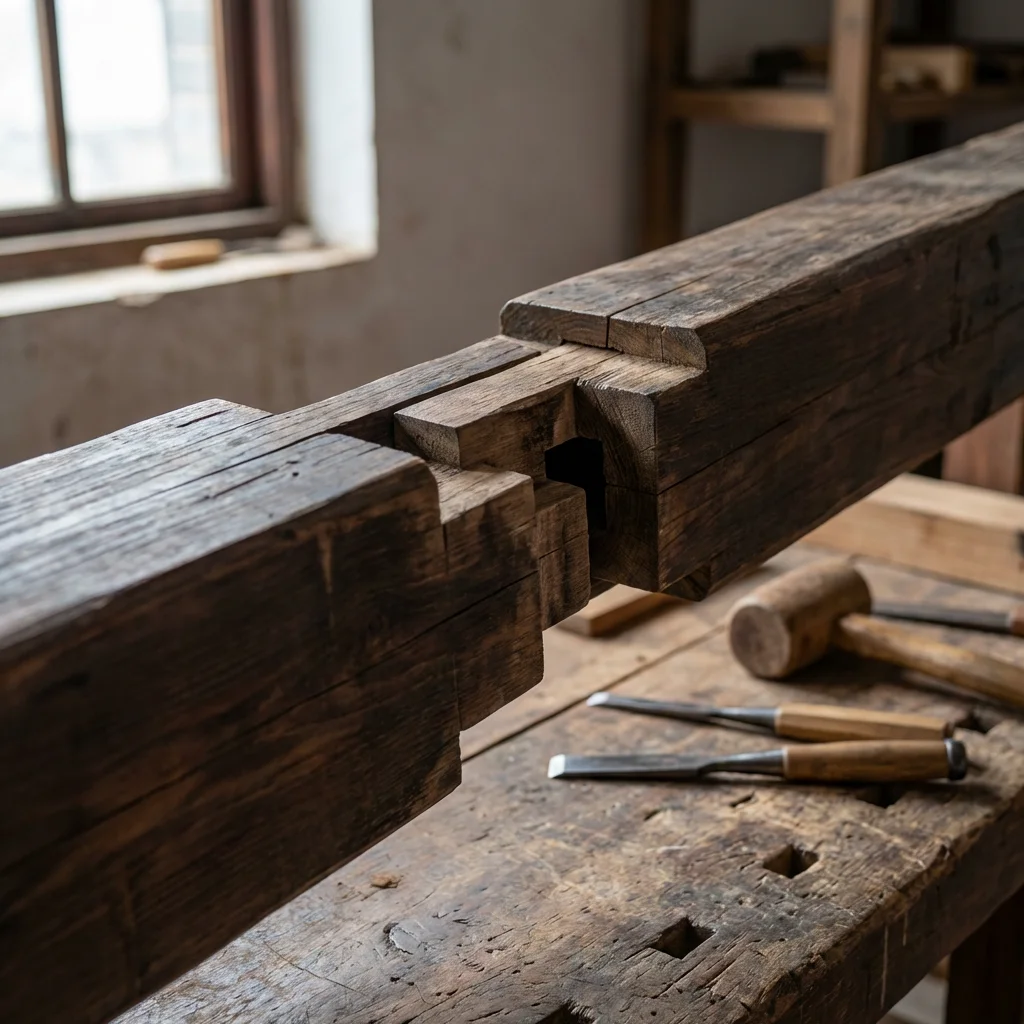
The **Sun** (Tenon) is the protruding part, and the **Mao** (Mortise) is the receiving hole. Together, they form a perfect union. This system relies on the natural expansion and contraction of the wood to lock the joints into place. Because no metal nails are used, there is no risk of rust or chemical reaction that could damage the wood over time. It is a system built on the idea of mutual support and balance, where each piece of wood is essential to the strength of the whole.
2. Earthquake Resilience: The Flexibility of the Joint
One of the most amazing features of Sun-mao architecture is its ability to survive massive earthquakes. Unlike rigid buildings held together by nails or cement, tenon-and-mortise structures can "sway" and "vibrate" during a tremor. The joints absorb the energy of the earthquake through friction and movement, preventing the building from collapsing. The 1,000-year-old Wooden Pagoda in Yingxian is a perfect example of this ancient "anti-seismic" technology in action.
3. Complex Joints: From Dove-tail to Cloud-joint
Chinese woodworking has developed hundreds of different types of joints, each designed for a specific structural purpose. The **Dove-tail** joint is used for corners, while the **Mitre-joint** is used for frames. The most complex is the "Cloud-joint" used in the bracket systems of palaces, which can involve dozens of interlocking pieces in a single assembly. This level of complexity required the carpenter to be both a skilled carver and a master mathematician, calculating the tolerances to a fraction of a millimeter.
4. Furniture Mastery: Seamless Strength
The same principles used in massive temples were also applied to the smallest pieces of Ming and Qing furniture. A high-quality Chinese chair or cabinet is held together entirely by Sun-mao joints. This makes the furniture remarkably durable and repairable, as pieces can be disassembled and reassembled without damaging the wood. It also allows for the clean, seamless lines that are the hallmark of classic Chinese furniture design.
5. FAQ: Understanding the Sun-mao System
Are nails never used in traditional Chinese architecture?
In high-status architecture (palaces, temples) and quality furniture, nails were strictly avoided. However, for simpler buildings and everyday tools, small wooden pegs (not metal nails) might be used to provide extra security for certain joints.
How long does it take to learn these joints?
Learning the basic joints takes months, but mastering the complex architectural systems takes many years of apprenticeship. It requires a deep "feel" for the wood and a physical memory of the different angles and tolerances required for a perfect fit.
Can modern machinery replicate Sun-mao?
While CNC machines can cut the basic shapes of tenon and mortise, the final "fit" always requires the human hand. Wood is an organic material that varies from piece to piece, and only a skilled carpenter can make the final adjustments to ensure a joint is tight but not stressed.
6. Conclusion
The tenon-and-mortise system is a testament to the scientific brilliance of our ancestors. It shows us that true strength comes from harmony and flexibility, not from force. As we admire the seamless joints of a Ming chair or the soaring beams of a temple, we are looking at the "silent wisdom" of the Sun-mao system. It is a connection that has held our culture together for three thousand years.
From the joint to the panel: Next, we explore the Art of Dividing Space—Screens and Panels!