Gold-Inlaid Ge Ware Phoenix-Ear Vase: A Masterpiece of Classical Aesthetics Where Gold Meets Jade
Heritage News
Editorial Team
In the magnificent tapestry of Chinese ceramic art, Ge ware (哥窑, Gē Yáo) holds an irreplaceable position, distinguished by its hallmark "golden wire and iron thread" crackle glaze and the characteristic "purple rim and iron foot." The gold-inlaid Ge ware-style phoenix-ear vase represents an innovative creation that builds upon the classical aesthetics of Ge ware while incorporating the art of metal inlay — a masterful synthesis of traditional craftsmanship and contemporary sensibility.
I. The Historical Origins and Cultural Depth of Ge Ware
Ge ware ranks among the celebrated Five Great Kilns of the Song dynasty — Ru, Guan, Ge, Jun, and Ding — and its history is steeped in legend. The earliest written record of Ge ware appears in Cao Zhao's Gegu Yaolun (Essential Criteria of Antiquities) of the Ming dynasty: "Old Ge ware is celadon in color, varying in shade, and also features the purple rim and iron foot." The Qing dynasty work Jingdezhen Tao Lu by Lan Pu records the legend of the "Gege Dong Kiln" and the "Brother's Kiln": during the Southern Song, two brothers named Zhang Sheng-yi and Zhang Sheng-er fired celadon in the Longquan region. The elder brother's kiln was called Ge ware, while the younger's became known as Di ware — the Longquan kiln. Though the legend may not perfectly reflect historical fact, it illuminates the deep connection between Ge ware and the Longquan tradition.
The golden age of Ge ware is generally attributed to the Song dynasty, yet scholars continue to debate its precise kiln site and period of production. Some believe Ge ware belongs to the Southern Song official kiln system; others argue it was produced from the Yuan dynasty onward. Regardless of exact dating, Ge ware left an indelible mark on Chinese ceramic history through its distinctive artistic style, and its crackle glaze technique exerted profound influence on all subsequent porcelain-making.
The cultural appeal of Ge ware lies at its core in the philosophy of "the beauty of imperfection." The crackle patterns on the surface of Ge ware vessels were originally firing "flaws" caused by the differing expansion coefficients of body and glaze — yet Song craftsmen brilliantly transformed them into a unique decorative language. This aesthetic ideal of finding beauty in imperfection, of discovering the natural within the incomplete, resonated deeply with the Song literati's philosophical pursuit of naturalness and artistic interest. The interlacing crackle lines — resembling ice fractures, grid patterns, or fish-roe textures — ensure that every piece bears a uniquely unrepeatable texture, embodying the Eastern wisdom of harmony between humanity and nature.
II. The Artistic Characteristics of Ge Ware Style
The artistic features of Ge ware-style ceramics can be understood across four dimensions: clay body, glaze color, crackle pattern, and rim-foot characteristics.
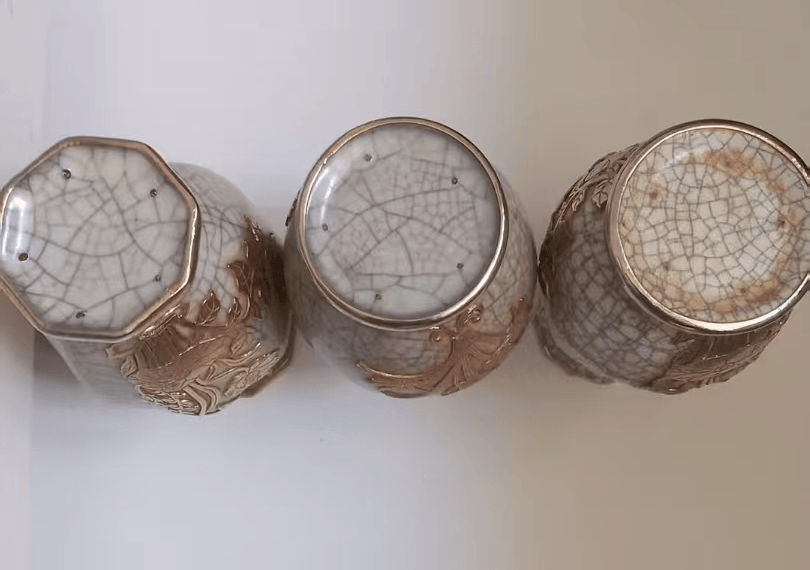
Clay body: Ge ware-style pieces typically use purple-gold clay with a high iron content. After firing, the body takes on a deep gray, purplish-black, or reddish-brown color. This dark body is faintly visible at the thinly glazed rim and foot edge, producing the signature "purple rim and iron foot" — a key criterion for identifying Ge ware style.
Glaze color: Ge ware-style glazes are predominantly celadon in hue, ranging from powder blue and ash-blue to moonwhite and cream. The glaze is thick and lustrous — rich as accumulated fat — and its surface sheen is soft and non-glaring, conveying the warm, jade-like quality of the finest materials. This restrained glaze effect reflects the Song ceramic aesthetic's pursuit of naturalness and simplicity.
Crackle pattern: This is the most distinctive artistic language of Ge ware. Due to the difference in expansion coefficients between body and glaze, the glaze contracts more than the body during cooling, producing naturally cracked lines. These patterns are poetically named according to their color and form: "golden wire and iron thread," "fish-roe pattern," "hundred-shard pattern," and "crab-claw pattern." The "golden wire and iron thread" refers to crackle lines where the broader cracks are black or dark brown and the finer ones are yellow or light brown — interlaced thick and thin, deep and shallow — producing a rich and complex visual effect. Far from diminishing the vessel's beauty, the crackle lines add layered depth and decorative richness, becoming the most vivid visual signature of Ge ware.
Rim and foot: As described above, the "purple rim and iron foot" is an essential identification feature. Where the glaze layer is thin at the mouth rim, the dark body shows through as a purple-brown tint; at the exposed foot ring, the clay appears iron-black or deep brown. This characteristic creates a warm-cool contrast with the ash-blue glaze tone, enriching the vessel's chromatic depth.
III. The Phoenix-Ear Form and the Art of Gold Inlay
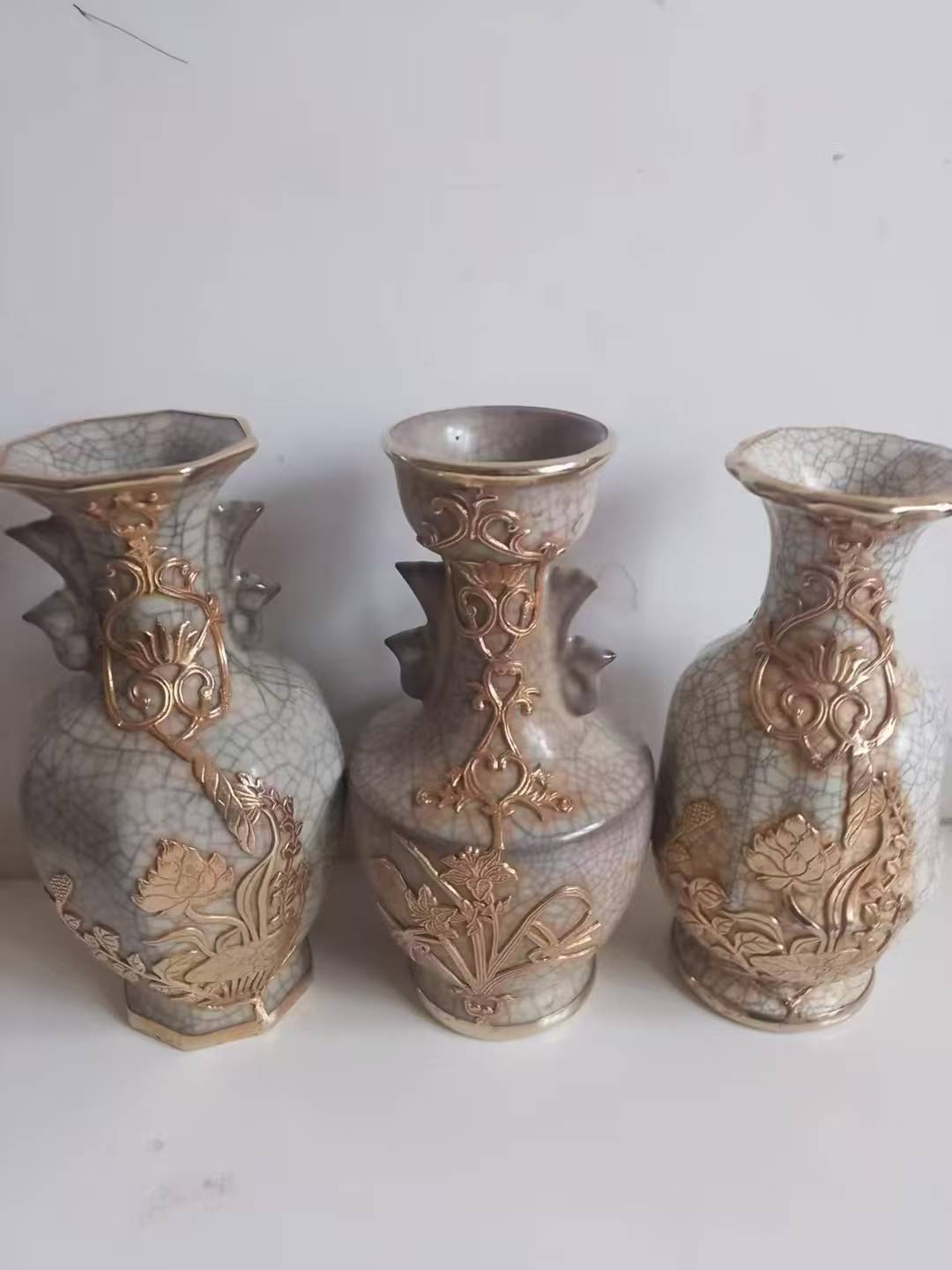
The phoenix-ear vase is one of the classic vessel forms in Chinese ceramic history. Its basic form features an elongated body, an upright neck, a plump and rounded belly, and a neatly formed foot ring. Two symmetrical phoenix-shaped handles are applied to both sides of the neck, with the phoenixes lifting their heads and spreading their wings in graceful, fluid lines. The phoenix-ear design not only breaks the monotony of the vase's silhouette but also imbues the vessel with cultural symbolism — the phoenix, in Chinese tradition, represents auspiciousness and nobility, making the phoenix-ear vase a carrier of hopes and blessings for a beautiful life.
The Ge ware-style phoenix-ear vase inherits the classical form while endowing the vessel with new artistic life through the distinctive texture of the Ge glaze. A thick celadon glaze is applied to the body, its crackle patterns naturally open and spacious, with "golden wire and iron thread" interlacing to create rich and subtle textural variation. The warmth of the glaze and the liveliness of the crackle complement each other, allowing the vessel to contain a vivid spirit within its stillness.
The introduction of gold inlay adds a new visual dimension to the Ge ware-style phoenix-ear vase. The tradition of gold-inlaid porcelain is ancient — gold and silver inlay techniques appeared as early as the Tang dynasty, and reached greater sophistication in the Ming and Qing periods. On the Ge ware-style phoenix-ear vase, gold decoration is typically applied at several key points:
Gold rim at the mouth: The most common treatment. A slender gold band is inlaid along the rim edge, simultaneously protecting the vessel's most vulnerable point from chipping while creating a contrast between the luster of metal and the warmth of glaze. The brightness of the gold border and the restraint of the Ge glaze illuminate each other, embodying the aesthetic ideal of "gold and jade radiant together."
Gold on the phoenix handles: More refined still — the phoenix's crest feathers, wings, or tail are partially gilded, whether wrapped in gold, inlaid with gold leaf, or traced with gold paint, making the phoenix form more vivid and striking. The pairing of gold and celadon — one warm, one cool; one bright, one subdued — dramatically enhances the decorative effect and visual impact.
Gold at the foot ring: This echoes the gilded rim and creates visual unity across the whole vessel. Some pieces also fill the crackle lines with gold powder or gold thread, intensifying the "golden wire" effect and making the crackle texture more pronounced.
The execution of gold inlay demands an extremely high level of technical skill. The gold components must be pre-fabricated according to the specific contours of each ceramic piece, then inlaid and secured with natural lacquer or special adhesives, before being polished to achieve a seamless, natural transition between gold and porcelain. This process requires both firm adhesion of the gold element and zero damage to the glaze surface — an exacting standard for any craftsman.
IV. The Mastery Behind the Making
The creation of a gold-inlaid Ge ware-style phoenix-ear vase integrates two core craft traditions — Ge glaze firing and metal inlay — each stage requiring precision and deep experience.
Clay body preparation is the first step. Purple-gold clay or high-iron-content porcelain clay is selected, then processed through washing, aging, and kneading until the clay body is smooth and uniform. The vase body is typically formed by mold-pressing or wheel-throwing, and may be built in segments that are joined together. The phoenix handles must be individually hand-modeled and sculpted, then attached to the body with fine clay slip — the joint must be worked until entirely seamless, with no visible join line. Once formed, the body is shade-dried and then trimmed to achieve uniform wall thickness and fluid contours.
Glaze application is the critical factor in determining the success of the Ge ware style. Ge glaze belongs to the thick-glaze system and requires multiple applications to reach the desired thickness. Each layer must dry before the next is applied; total glaze thickness can reach 1 to 2 millimeters. The glaze recipe incorporates plant ash, purple-gold clay, and other components to produce the characteristic opalescence and crackle properties. During glazing, the thickness at the rim and foot must be carefully controlled to achieve the intended "purple rim and iron foot" effect.
Firing requires precise control of kiln temperature and atmosphere. Ge ware-style ceramics are generally fired in a reducing atmosphere at approximately 1,200°C to 1,250°C. The rate of temperature increase during firing must be controlled to allow full interaction between body and glaze. The cooling phase is even more critical — rapid cooling promotes fine and dense crackle, while slow cooling yields broader crackle. Master craftsmen manipulate cooling speed to govern the form and density of the crackle, achieving the intended artistic effect.
Gold inlay is performed after the ceramic has been fired. The areas to be gilded are first grooved or abraded to create sufficient surface roughness for adhesion. The gold components are pre-formed using hammer-shaping and chasing techniques, with pattern designs coordinated to complement the Ge ware aesthetic. Natural lacquer serves as the adhesive to fix the gold pieces into position; the work then proceeds through pressing, shade-drying, polishing, and buffing until the gold inlay is firmly united with the porcelain body, the transition invisible and natural.
V. Collecting Value and Cultural Transmission
The gold-inlaid Ge ware-style phoenix-ear vase holds artistic, craft, and cultural value across multiple dimensions.
From an artistic standpoint, the work fuses the distinctive beauty of Ge ware crackle glaze with the splendid precision of gold inlay. The philosophical ideal of "transforming imperfection into beauty" inherent in Ge ware harmonizes beautifully with the opulent grandeur of gold ornamentation, producing an artistic statement that carries both classical sentiment and contemporary aesthetic sensibility. Each piece bears a uniquely unrepeatable glaze palette and crackle texture — an irreproducible artistic character.
From a craft standpoint, both Ge glaze firing and gold inlay belong to the most technically demanding of traditional arts. The glaze formula, the technique of applying thick glaze, the control of crackle, the management of kiln temperature — all require years of accumulated practice. Gold inlay further demands that the craftsman be equally proficient in metalworking and ceramic restoration. As the community of masters who have internalized these skills continues to dwindle, each carefully made piece bears the weight of transmission.
From a cultural standpoint, the gold-inlaid Ge ware-style phoenix-ear vase carries the spiritual core of Song dynasty aesthetics while expressing the innovative exploration of contemporary craft arts. The Ge ware philosophy of "the beauty of imperfection" flows in the same vein as the Eastern philosophical reverence for nature and acceptance of incompleteness. To collect such a work is both a tribute to classical aesthetics and a concrete act of participation in cultural transmission.
VI. Significance for Transmission and Future Horizons
The creation and collecting of gold-inlaid Ge ware-style phoenix-ear vases represents an important expression of traditional craftsmanship continuing to develop in the contemporary era. The unique beauty of Ge ware's crackle glaze has endured for centuries without diminishing — still moving hearts today — proof of the vitality of traditional craft. The introduction of gold inlay breathes new expressive possibility into this classical beauty.
In contemporary craft arts, the question of how to innovate while honoring tradition is one worthy of deep reflection. The practice of the gold-inlaid Ge ware-style phoenix-ear vase demonstrates that organic fusion across different craft disciplines can, while preserving the essence of each tradition, generate new artistic possibilities. This approach of "cross-disciplinary synthesis" offers meaningful inspiration for the contemporary development of traditional crafts.
In sum, the gold-inlaid Ge ware-style phoenix-ear vase occupies a singular place in contemporary ceramic art through its extraordinary crackle glaze beauty, its refined gold inlay craftsmanship, and its profound cultural heritage. It stands as both a tribute to the Song dynasty Ge ware aesthetic tradition and an innovative development of traditional craft within the contemporary context. Whether approached from the perspective of artistic appreciation or cultural transmission, this is a work that rewards deep contemplation and lasting regard.