


 Posted an update: 2026-4-1 14:10:40 110
In the rivers of the Kunlun Mountains, the treasure is born from the snow. Hetian jade is the "royal" stone of China, the white gold of the desert that has graced the hands of every emperor.
Hetian Jade: The Royal Treasure of Xinjiang and the White Gold of the Silk Road
For over 3,000 years, the city of Hetian in Xinjiang has been the primary source for China"s most valuable jade. Known for its soft, "greasy" luster and its extreme toughness, Hetian jade (Nephrite) is the traditional "Jade" of the Chinese scholars and rulers. Whether it is the brilliant "Mutton-fat White" or the deep "Spinach Green," Hetian jade is the standard by which all other stones are measured. It is the heart of the Silk Road and the soul of the imperial court.
1. Mutton-Fat White: The Ultimate Quality
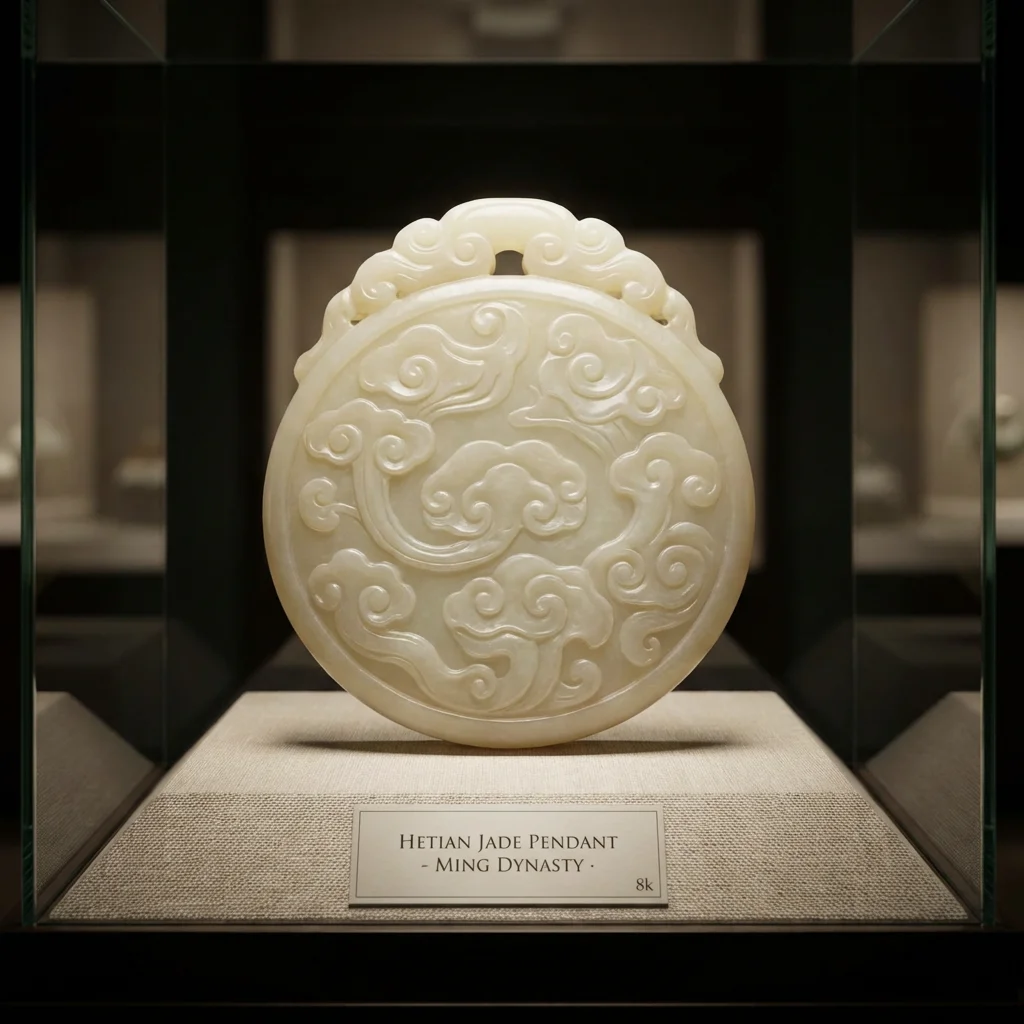
The most prized variety of Hetian jade is Yang-zhi-bai-yu (Mutton-fat white jade). This stone is so pure, white, and translucent that it resembles the solid fat of a sheep. Its luster is not like the sharp shine of a diamond, but a soft, internal glow that seems to come from within. For ancient scholars, this soft white color represented the "perfect virtue" of a true gentleman—powerful but gentle, clear but deep.
2. The Kunlun Mountains: Born from the Dragon"s Veins
The best Hetian jade is found in the rivers that flow from the Kunlun Mountains. Known as Zi-liao (Seed jade), these are pieces of jade that have been naturally eroded from the mountain peaks and polished by river water for thousands of years. This natural process makes the stone extremely dense and smooth, with a thin "skin" of iron-oxide that carvers often use as part of their design. These river stones are the "Dragon"s Veins," carrying the raw power of the mountains.
3. The Jade Road: Before the Silk Road
Long before the Silk Road became famous, there was the **Jade Road**. For millennia, caravans carried Hetian jade across 3,000 miles of desert and mountain to reach the central plains of China. This trade route was the first bridge between China and the West, bringing not only stone but also ideas and culture. The demand for Hetian jade was so great that it sustained entire civilizations along the Taklamakan Desert for centuries.
4. Texture and Spirit: The "Warmth" of Nephrite
Unlike the glassy feeling of jadeite, Hetian jade has a unique **Texture** that carvers describe as "warm" or "greasy" (Wen-run). When held in the hand, it quickly matches the body"s temperature and feels like a living part of the person. This physical "warmth" is why Hetian jade has always been the preferred stone for personal items like seals, bangles, and pendants. It is a stone that you don"t just look at; you live with it.
5. FAQ: Collecting Hetian Jade
How do I identify real Hetian jade?
Look for the "greasy" luster and the fine, dense grain. If you shine a flashlight through it, the light should be soft and even, without the "ice-like" crystals seen in jadeite. Also, Hetian jade is extremely tough and will not chip easily, unlike many common substitutes.
Why is "Seed Jade" so expensive?
Seed jade is rare because it must be naturally tumbled and polished by the river for thousands of years. Its density and its natural "skin" make it much more valuable to carvers and collectors than jade that is mined directly from the mountain (Shan-liao).
Can Hetian jade be green or black?
Yes! While white is the most famous, Hetian jade comes in many colors, including "Spinach Green" (Bi-yu), "Ink Black" (Mo-yu), and even "Sugar Brown." Each color has its own beauty and its own group of dedicated collectors.
6. Conclusion
Hetian jade is the gold of the Chinese heart. It is a testament to the eternal beauty of nature and the incredible endurance of our culture. As we touch the soft, white surface of a Hetian pendant, we are touching the snow of the Kunlun Mountains and the history of a thousand caravans. Hetian jade is not just a stone; it is the royal memory of the Silk Road.
From the mountain to the ritual: Next, we explore the Neolithic Rituals—The Art of the Jade Bi and Cong!