
Zisha teapots also belong to the category of art. We all know that the longer a piece of art is, the higher its collection value will generally be. For example, Zisha teapots, but this is conditional on ensuring the clay, shape, craftsmanship, style, and who made them. We must know that not all old pots are valuable. So if you want to know how much a pot was worth 20 years ago, you need to first look at these conditions of your pot and then go through professional appraisal.
Similar Posts
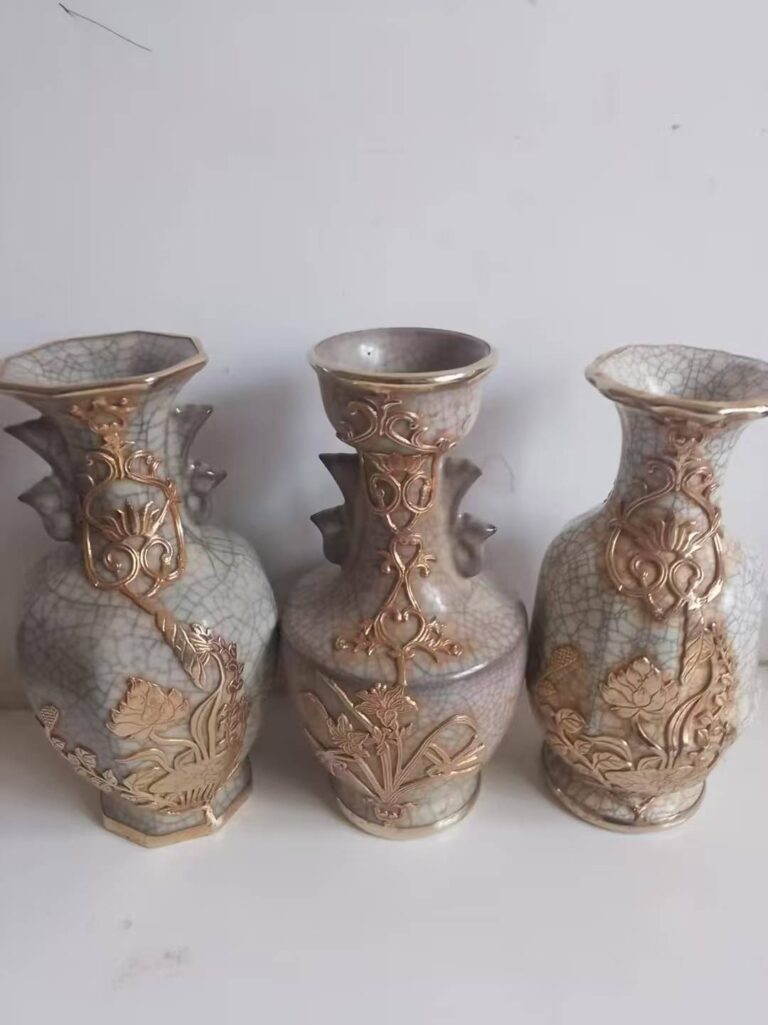
Gold-Inlaid Ge Ware Phoenix-Ear Vase: A Masterpiece of Classical Aesthetics Where Gold Meets Jade
In the magnificent tapestry of Chinese ceramic art, Ge ware (哥窑, GÄ“ Yáo) holds an irreplaceable position, distinguished by its hallmark “golden wire and iron thread” crackle glaze and the characteristic “purple rim and iron foot.” The gold-inlaid Ge ware-style phoenix-ear vase represents an innovative creation that builds upon the classical aesthetics of Ge ware…
A Brief Talk on Filigree Inlay Craft
Filigree inlay, also known as fine goldcraft, is one of the “Eight Imperial Handicrafts of Yanjing”alongside cloisonné, jade carving, ivory carving, carved lacquer, gold-inlaidlacquer, imperial carpets, and Beijing embroidery. In 2008, the craftsmanshipof filigree inlay was included in the national intangible cultural heritagelist. Filigree inlay has been passed down inChina for over 2,000 years and…
What are the contemporary masters of purple clay teapots surnamed Wu?
Wu Jiechun, Wu Jufang, Wu Fangdi, Wu Xiaoping, Wu Zhenyu, Wu Ming, and Wu Kouhua are all national senior craft artists
Cloisonne Mirror Backs: A Shimmering Fusion of Bronze Casting and Enamel Art
Table of Contents Cloisonne Mirror Backs: A Fusion of Bronze and Glass Art Reflecting Beauty: The Ritual Role of the Mirror The Fusion Secret: Soldering Enamel to Bronze Personal Adornment: Mirror Backs as Luxury Accessories Frequently Asked Questions Cloisonne Mirror Backs: A Fusion of Bronze and Glass Art The cloisonne mirror back (BÇŽojìng) represents one…
Cloisonne Brush Pots: Scholarly Gems and Intellectual Luxury of the Qing Court
Table of Contents Cloisonne Brush Pots: Scholarly Gems of the Qing Court The Scholar”s Desk: Where Art Meets Function Symbolic Scenery: Landscapes and Literati Themes A Global Symbol of Intellectual Luxury Frequently Asked Questions Cloisonne Brush Pots: Scholarly Gems of the Qing Court During the Qing Dynasty, cloisonne reached beyond grand palace vases to the…
What are the purple clay artists surnamed Du?
What are the purple clay artists surnamed Du? Du Qiu, Du Fei, Du Yanhua, Du Qing, Du Juan, Du Jie, Du Wenya, Du Furong, Du Xuezhi, Du Qiang, Du Wenjie, etc.