Chinese porcelain tea sets emerged after pottery, and once porcelain was invented, clay tea vessels were gradually supplanted by their ceramic counterparts. Porcelain tea ware can be broadly classified into three principal categories: white porcelain (baici), celadon (qingci), and black porcelain (heici), each with its own distinct aesthetic, technical tradition, and cultural lineage.
I. White Porcelain Tea Sets — Baici
White porcelain tea ware is distinguished by a dense, translucent body, high firing temperature, zero water absorption, and a clear, lingering ring when struck. The glaze is as white as jade — hence the classical description bai ru yu ("white as jade"). Major production centres include Jingdezhen in Jiangxi, Liling in Hunan, Dayi in Sichuan, Tangshan in Hebei, and Qimen in Anhui, but Jingdezhen remains the undisputed master. Its porcelain has been celebrated for centuries with the four-word accolade: white as jade, thin as paper, bright as a mirror, resonant as a chime stone.
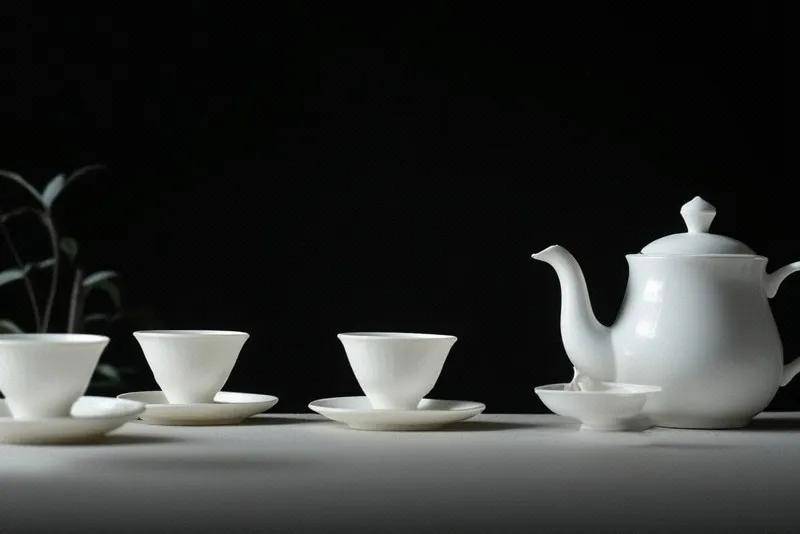
As early as the Tang Dynasty, white porcelain was already nicknamed jia yu qi — "imitation jade ware." By the Northern Song, Jingdezhen kilns were producing porcelain of extraordinary thinness and lustre, with a faint blue-green undertone beneath the white glaze, enhanced by yingqing (shadow-blue) incised decoration, floral printing, and iron-brown dot patterns. During the Yuan Dynasty, Jingdezhen white porcelain tea sets were already exported overseas. By the Ming, the town had become the porcelain capital of China. Today, the Jingdezhen blue-and-white tea sets that dominate the market continue this lineage: while rooted in traditional craftsmanship, they have evolved a wealth of new forms — whether teapot, teacup, or tea tray — that embody both rich ethnic character and a distinctly modern Eastern sensibility. Jingdezhen ware remains one of the most ubiquitous tea sets in use today.
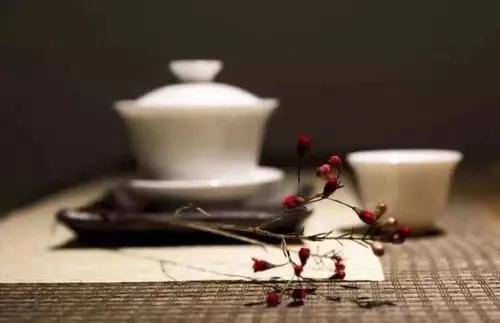
Because of its immaculate white surface, white porcelain accurately reflects the colour of the tea liquor when brewing. It offers moderate heat conduction and retention, comes in an endless variety of colours and forms, and is rightly regarded as a treasure among tea-drinking vessels.
II. Celadon Tea Sets — Qingci
The finest celadon tea ware has historically come from Zhejiang Province. As early as the Jin Dynasty, Zhejiang was already the heartland of celadon production, with the Yue, Wu, and Ou kilns operating on a considerable scale. By the Song Dynasty, the Longquan celadon of Zhejiang — produced by the legendary Ge Kiln, one of the Five Great Kilns — had reached its zenith. The repertoire included teapots, tea bowls, tea saucers, teacups, and tea trays, exported across China and far beyond its borders.
Longquan celadon is celebrated for its elegantly archaic, robust forms and a glaze of jade-like, kingfisher-green translucency. It stands as a singular marvel in the garden of Chinese ceramics, hailed as the flower of porcelain. The Longquan kilns are situated in the southwestern reaches of Zhejiang, an area that numbers among the most historically significant porcelain-producing regions in China. By the Southern Song, Longquan had become the largest kiln centre in the entire empire: its finest wares not only circulated widely among the populace but also constituted a principal commodity in the imperial court's overseas trade.
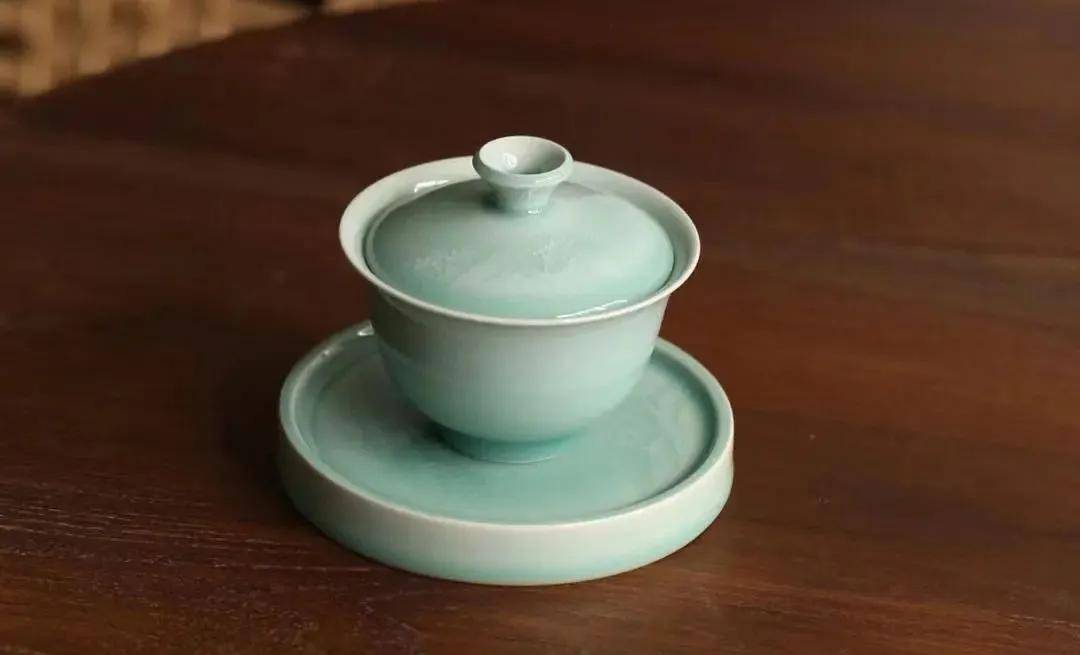
The art reached its apogee under the brothers Zhang Shengyi and Zhang Sheng'er, whose respective Ge Kiln and Di Kiln products attained extraordinary heights in both glaze and form. Ge Kiln was ranked among the Five Great Kilns, while Di Kiln was prized as the giant among famous kilns. Ge Kiln ware is characterized by a thin body of exceptional hardness and a thick, full glaze of subdued, meditative colour — powder-green, kingfisher-green, ash-grey, and crab-shell-blue, with powder-green being the most precious. Its glaze surface displays a network of crackle lines in endlessly varied patterns: crackle of mixed fine and coarse lines is known as civil-military crackle (wenwu pian), fine pinhole crackle as fish-roe crackle (yuzi wen), ice-crack patterns as Arctic shatter (beiji sui), and there are also crab-claw lines, eel-blood veins, and ox-hair striations. These distinctive decorative effects arise from the differential contraction of body and glaze during firing, bestowing a beauty born of controlled imperfection — the aesthetic of shattered pattern.
Di Kiln ware, by contrast, is celebrated for graceful form, a thick and sturdy body, and a glaze of kingfisher-green purity and lustrous translucency, with varieties including plum-green, powder-green, bean-green, and crab-shell-blue — plum-green and powder-green being the finest. Its moist, unctuous powder-green rivals the finest jade, while its crystalline plum-green captures the freshness of spring itself. The sheer beauty of its glaze remains, to this day, without equal anywhere in the world.
Celadon tea ware, with its refreshing green tones, is at its best when used for brewing green tea, where it enhances the appreciation of the liquor's colour. When used with black tea, dark tea, or oolong, however, it may skew the perceived colour of the infusion — a subtle but acknowledged limitation.
III. Black Porcelain Tea Sets — Heici
Black porcelain is fired with a high-temperature black glaze, the colour deriving from a high iron content. Production centres span Zhejiang, Sichuan, and Fujian. Black-glazed tea ware rose to prominence during the Song Dynasty, driven by the flourishing culture of tea competition (doucha). Veteran contestants knew from experience that the black-glazed bowls from the Jian'an kilns (in present-day Fujian) were the ideal vessel for the practice, and their fame spread accordingly.
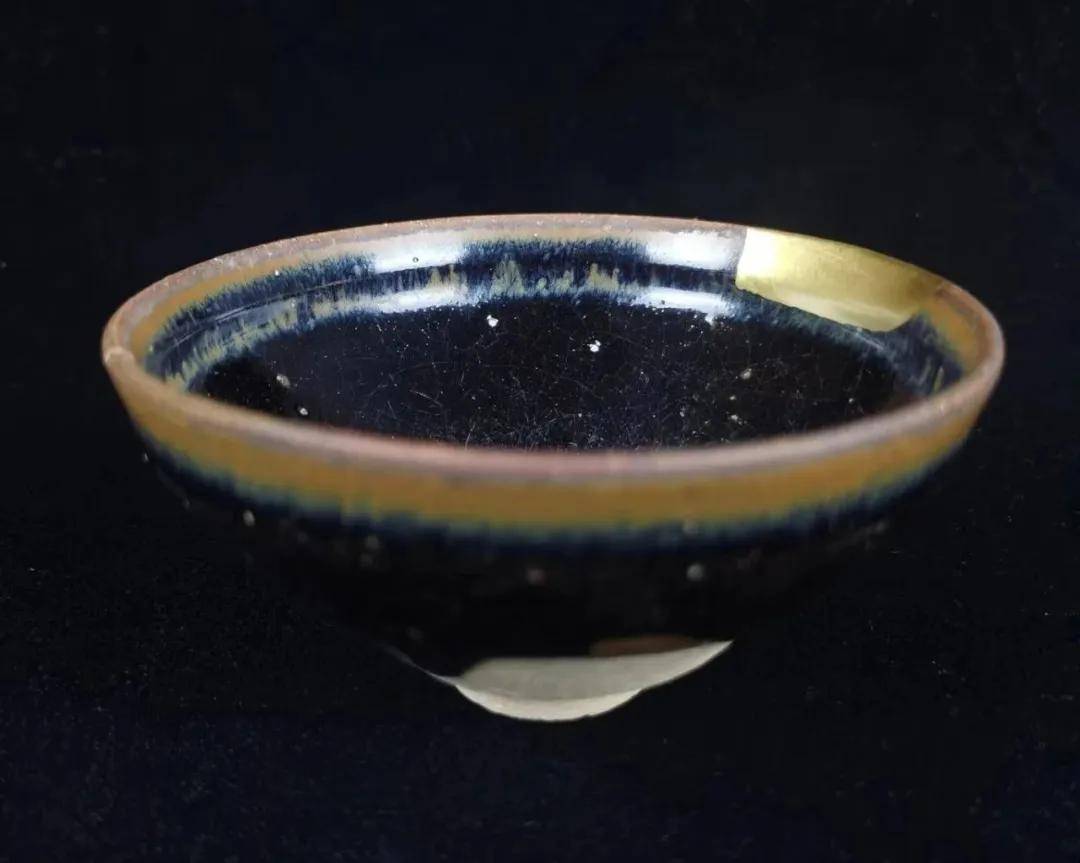
The Northern Song tea master Cai Xiang recorded in his Record of Tea: "When the tea foam is white, a black bowl is suitable. Those made at Jian'an are a deep purplish-black, with streaked markings like hare's fur; the body is slightly thick, and once heated, it stays hot for a long time — this is the most essential quality. Those made elsewhere are either too thin or purple in hue, and none can compare. As for the blue-white bowls, the tea-competition connoisseur would never use them."
The black-glazed tea bowls from the Guangyuan kilns of Sichuan match Jian ware so closely in form, body, glaze colour, and hare's-fur markings as to be almost indistinguishable. The Yuyao and Deqing regions of Zhejiang also produced lustrous, jet-black glazed tea ware of great beauty and practicality, the most popular form being the chicken-head ewer — a teapot whose spout was modelled in the shape of a rooster's head. The Tokyo National Museum in Japan still treasures a Heavenly Chicken Ewer from this tradition, regarding it as a national treasure.
Because of the high iron content in the glaze, the extended holding time in the kiln, and firing in a reducing atmosphere, a profusion of iron-oxide crystals precipitates within the glaze during firing, producing a surface alive with iridescent, flowing patterns of extraordinary variety. Every piece, when examined closely, constitutes its own self-contained microcosm — a one-of-a-kind treasure among tea utensils.